
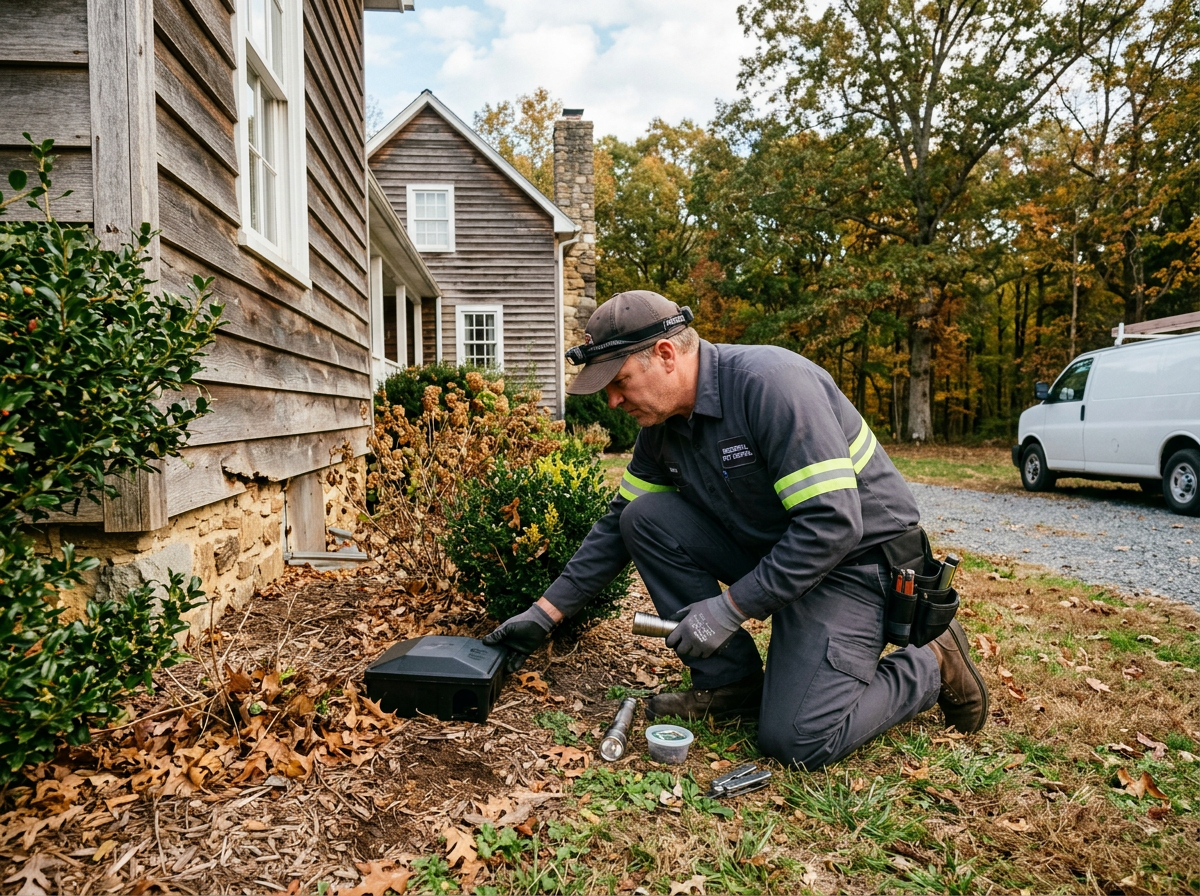
In Midlothian homes built on clay soils, house mice and Norway rats commonly enter through gaps around foundation vents, dryer exhausts, and utility lines where the soil shifts after wet winters. Technicians start by walking the full perimeter at dusk to watch travel lines along brick foundations and under decks, then move inside to check insulation in crawl spaces and attics for nesting material. Bait stations placed without first closing holes simply train rodents to travel farther for food, so the first real step is always mechanical exclusion using metal mesh and concrete patch on every opening larger than a dime.
Roof rats appear more often in older Northern Virginia and Tidewater neighborhoods where mature trees overhang roofs and allow access through soffit vents. Once inside, they follow plumbing stacks into wall voids and leave droppings along rafters. Interior trapping programs use multiple trap types placed along these runways rather than single stations, and follow-up visits check for new chew marks on wires or stored items. When a neighbor’s shed or woodpile remains untreated, mice continue to repopulate the same crawl space, which is why every job includes a written list of off-property sources that the homeowner must address.
Rodent Control Near You — Choose Your City
Every city below has its own local Rodent Control page with coverage details.
Albemarle County
Fairfax County
Prince William County
Independent City
Nottoway County
Henrico County
Loudoun County
Orange County
Essex County
Shenandoah County
King George County
Poquoson
Pittsylvania County
Radford
Powhatan County
Spotsylvania County
Other areas
Dickenson County
Fairfax
Floyd County
Brunswick County
Middlesex County
Amelia County
Mathews County
Henry County
Augusta County
Greene County
Halifax County
King William County
Frederick County
Mecklenburg County
Gloucester County
Washington County
Virginia’s spring rains push rodents from outdoor burrows into garages and sheds where they chew through stored cardboard and insulation. Exclusion work here focuses on bottom seals on overhead doors and gaps around water spigots. Technicians also remove accessible nesting debris during the initial visit so fresh droppings can be monitored on return trips. The limit is clear: if rodents are still entering from an untreated drainage ditch or retention pond nearby, trapping alone will not end the pressure.
Technician insight
In Midlothian, the thing that catches most people out with Rodent Control is how clay soil around 1980s brick homes opens new gaps after every hard rain, letting mice back in through the same foundation vents that were sealed the month before.
Midlothian Crawlspace Re-Entry
Mice kept returning to insulation under a 1990s ranch after repeated bait use. Inspection found three open dryer vents and a loose foundation vent hidden by landscaping. Sealing those points plus a short trapping run inside the crawl space ended activity within two weeks.
Rodent Control Services We Offer
✓Entry-Point Exclusion and Sealing
Technicians locate and close every opening larger than a dime around foundations, vents, and utility penetrations using metal mesh and concrete to prevent rats and mice from re-entering.
✓Rodent Inspection
A full property walk-through that maps runways, nests, and chew damage in attics, crawl spaces, and outbuildings so treatment targets actual travel routes rather than guesswork.
✓Interior Trapping Programme
Multiple trap placements along established runways inside the structure, checked on scheduled follow-up visits until fresh activity stops.
✓Attic and Crawlspace Rodent Cleanup
Removal of nesting material and droppings from insulation and joists followed by sanitation treatment to reduce odor and disease risk after rodents are excluded.
✓Perimeter Baiting and Monitoring
Tamper-resistant stations placed along foundation lines and fence rows to intercept rodents traveling from nearby ditches or woodpiles before they reach the house.
✓Garage and Shed Rodent Control
Targeted sealing of overhead doors, vents, and stored-item stacks combined with trapping to stop mice from nesting in cardboard and equipment.
How it works
- 1
Property Inspection
Technician walks the full exterior and interior at dusk to identify entry points, runways, and nesting areas specific to Midlothian clay soils and older brick construction.
- 2
Exclusion Work
All openings larger than a dime are sealed with metal mesh and concrete before any bait or traps are placed.
- 3
Trapping and Monitoring
Stations and traps are set along confirmed travel routes and checked on return visits until activity ceases.
- 4
Follow-Up and Source Advice
Written list of off-site breeding areas is provided so the homeowner can reduce pressure from neighboring properties.
Pricing
Scope changes with the number of entry points, size of the structure, and whether attics or crawl spaces require cleanup; call for an on-site inspection.