
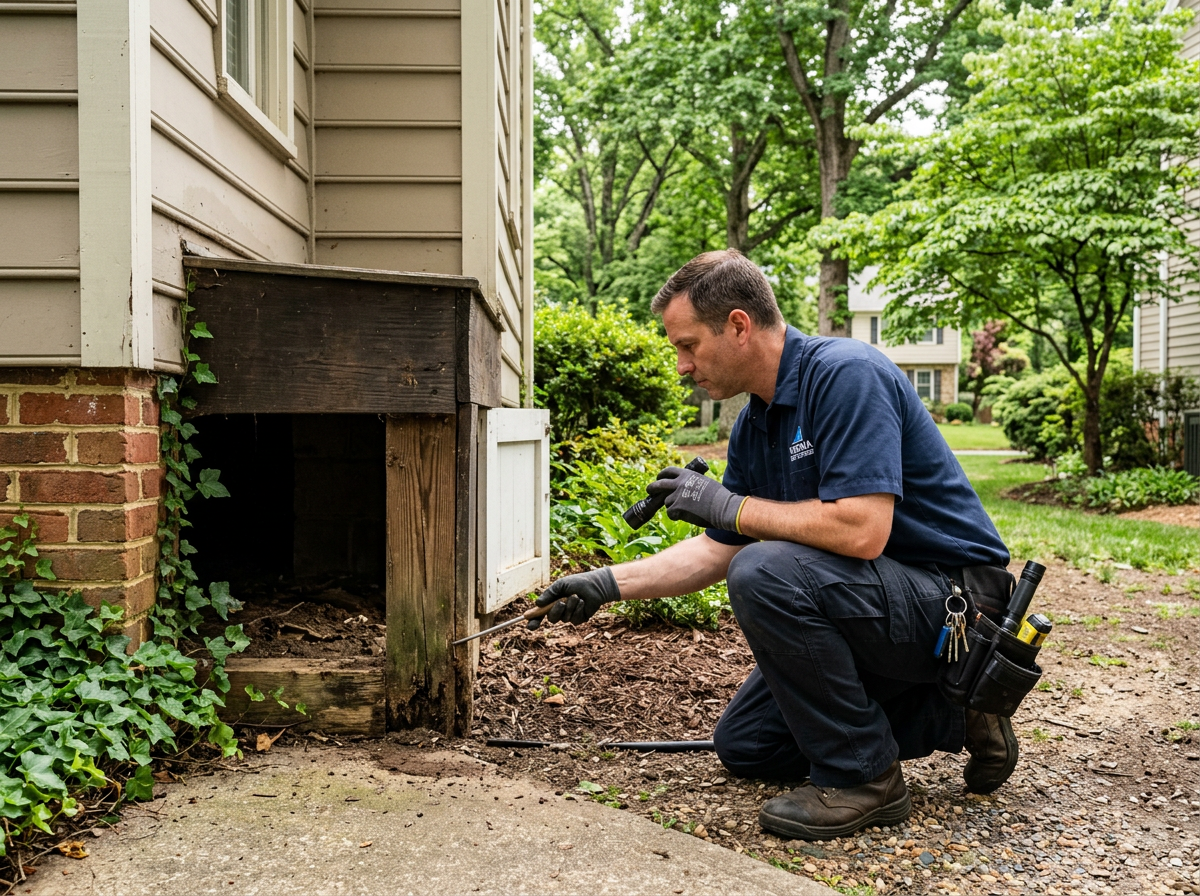
Fairfax Station features mature wooded subdivisions and suburban parks where storm drains and shaded yards create consistent conditions for mosquitoes and other pests. Access via I-66 and VA-123 allows crews to reach properties efficiently year-round.
Housing stock ranges from established homes near Burke Lake Park to newer sections in Burke Centre, all benefiting from seasonal programs that match the humid subtropical climate and four-season cycle.
Here's how our termite inspection work runs in Fairfax Station — the same standards we hold across Virginia, delivered by the crew that covers Fairfax County.
Termite Inspection Services We Offer in Fairfax Station
✓Crawl Space Termite Inspection
Full crawl-space survey for mud tubes, damaged joists, and soil contact points typical in Midlothian homes with pier-and-beam construction.
✓Foundation Perimeter Inspection
Exterior check of slabs, expansion joints, and weep holes where subterranean termites enter from the surrounding clay soil.
✓Wood-Destroying Insect Report
Written report documenting active or previous termite evidence required for real-estate transactions in central Virginia.
✓Moisture Source Identification
Assessment of plumbing leaks, poor grading, and HVAC condensation that create the damp conditions termites need to survive.
✓Attic and Framing Inspection
Inspection of roof sheathing, rafters, and top plates for hidden galleries that start from below-grade entry points.
Subterranean termites in the Midlothian area travel through clay-heavy Piedmont soils that stay damp for weeks after rain, letting them reach untreated wood without surfacing. Homes built from the 1970s onward often have crawl spaces with poor ventilation and soil-to-wood contact at sills and piers, giving colonies direct access. A proper inspection requires lifting insulation, probing baseboards, and checking expansion joints where mud tubes form overnight once humidity rises.
Daytime visual checks miss active foraging when tubes are broken or soil has been disturbed by recent grading. Technicians follow utility lines and plumbing penetrations because termites use these as highways from the ground into framing. In neighborhoods with retention ponds or French drains that stay wet, colonies can bridge chemical barriers by building new shelter tubes along the moist paths, which is why re-inspection after heavy rain is often needed.
How It Works in Fairfax Station
- 1
Exterior Walk-Around
Examine the foundation, siding, and grade for mud tubes, shelter tubes, and soil-to-wood contact around the entire perimeter.
- 2
Crawl Space Entry
Probe sills, piers, and subflooring while checking for active termites and moisture issues common to local clay soils.
- 3
Interior Probing
Check baseboards, door frames, and utility penetrations inside the home for hidden damage or galleries.
- 4
Report and Recommendations
Document findings and note conditions that require follow-up monitoring or treatment by a qualified applicator.
Serving All of Fairfax Station
We regularly handle termite inspection jobs near:
- 📍Fairfax Station Railroad Museum
- 📍Burke Lake Park
Termite Inspection Pricing in Fairfax Station
Inspection scope varies with home age, crawl-space access, and square footage; call to schedule and receive a site-specific quote.
Want the full picture of this service? See our Termite Inspection page, or everything we do in Fairfax Station, VA.